
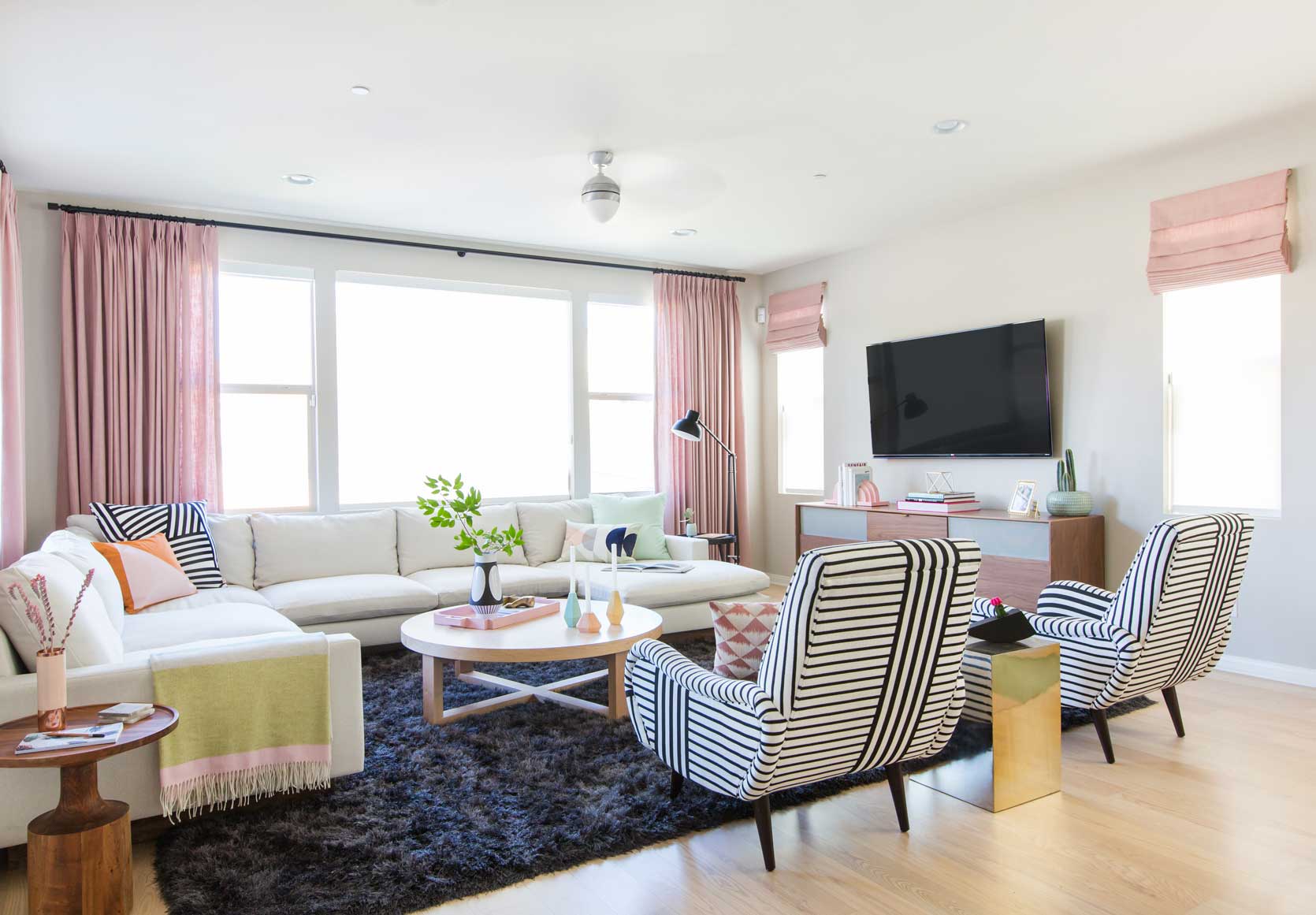
If you Google “what size should my media cabinet be?” or something of that nature, you’re likely going to keep seeing the same response echoed throughout other publishers or manufacturers: Your entertainment console should be 3 to 6 inches larger on each side than the TV in the center, though ideally, that televsion would be roughly 2/3 the size of the cabinet beneath it. The average flat panel sold today is 55 inches (though my research says 65 is quickly becoming more common), which means the smallest sized cabinet you should be pairing with your TV is about 82 inches.
Allow me to play the contrarian here and say that, no offense to anyone who wrote that (as it’s not technically wrong), but I think a media cabinet looks best when it’s wider than that. I understand that not all rooms can handle such a large piece of furniture (I’ll go into that below because I like to be thorough), but allow me to rewrite the rule: Your media console should be roughly the same width as your SOFA. Sure, your TV size matters, but if you want to achieve one of the most important aspects of a room’s design—balance—taking dimension cues from your seating, rather than your television, is the way to do that.
Think of it like you would the rug in your living room; it needs to be scaled appropriately to the size of your sofa or sectional. To me, the same rule should apply to your media console or entertainment center. Anything smaller, especially if you have a large TV set, and the furnishing will be dwarfed by it. Like wearing giant shoulder pads with a tapered ankle pant…totally top heavy.
If you’re here just skimming for the takeaways, here’s a quick summary of what I just said to avoid the “too small console” design mistake:
Old rule: TV should be 2/3 the width of your cabinet
New rule: TV cabinet should roughly match the size of your sofa or sectional (even wider if you have an expansive room in a modern style).
Where The Rule Doesn’t Work
As I mentioned, I’m realistic enough to know that “the bigger the better” doesn’t work for every room or even every home. Low, wide media cabinets often come off feeling more contemporary in style, though there are certainly plenty of traditional-leaning designs on the market now, as well.
Let’s take my previous home (above), for instance. Our apartment’s building was built in the 1930s, so they didn’t design living spaces with “where does the TV go?!?” in mind. We didn’t want to put our LED panel above the fireplace, both because it wouldn’t have even fit properly, and because, as renters, we didn’t want to drill into a fireplace that wasn’t ours. Instead, we added a cabinet to a little alcove to the left of it. Our sofa is about 90 inches wide, and no cabinet of that size would fit in there. Nor would it match the old Mediterranean style of the architecture.
The Article Seno sideboard I used was 71 inches, which means it didn’t even fit the 2/3 rule for my 55-inch TV. I could have gone a little bit bigger in that space, though not much if I didn’t want the fireplace hearth to feel like it was sitting right on top of my Gilmore Girls binge rewatches. And guess what? It was totally fine. It looked great, but that’s because it suited the room size and layout.
I wanted to include this beautiful room by our friends at Velinda Hellen Design because it tells a slightly different story. The sources for the cabinet aren’t listed, but I know an IKEA Besta unit anywhere (I have four of them in my home). Normally, I’d say something of this width is too small paired with a sizable sectional such as this one, but, because it’s wedged into a custom build-out with additional shelving on the size, it becomes part of a larger visual unit that better suits the room in terms of scale.
When The Rule Works Best
Before showing you the next example (which I think will make you instantly go, “OH YES I UNDERSTAND NOW”), I want to say that the extra-wide media console works best in a room that is large and open, or against a long stretch of empty wall. Often, I find people put a 60-inch cabinet beneath their 50-inch TV, and then stuff the rest of the wall with other things to fill the void. Plants, chairs, bookcases, large floor vases or baskets…when a singular furnishing takes up more space, you don’t need all that other fluff. This actually works in favor of bringing down the visual noise of a room, even if the piece itself is much larger.
Below is a “before” photo of the living room in Mallory’s parents’ home, which has a media cabinet of a very common size:
BUT THEN! Mallory redecorated and chose two walnut sideboards from AllModern that went nearly wall-to-wall, and the entire presence of this room changed. Here, the TV is half the width of the abutting cabinets, and with the addition of the floating wall shelves, it feels less about the TV and more about a well-filled-out room that doesn’t feel stuffy or crowded.
I keep talking about my Besta, and here it is. It’s a little wonky thanks to a toddler who loves to pull down on the doors often in search of toys and games, but it fills the 20-ish-foot wall of my living room well. Honestly, it could be wider, but I didn’t want to buy anything new for this place, as it was always meant to be temporary. This used to live in my previous dining room, but I swapped the Article sideboard for this because it worked better this way in our current floorplan. That Seno would have looked so dinky on this giant wall, especially given the ceilings are something like 15-feet tall in here.
Now, it’s time to see what’s out there on the market if you intend to redecorate or start fresh. Of course, secondhand is always a great option, so be sure to check around those marketplaces, as well, though vintage likely isn’t an option here due to the size. And of course, my final caveat is that if your media console is working fine for your home and your room, leave it alone. Sure, the title of this post is “Design Mistake,” but in my opinion, that really only applies to anyone on the market for a media console who is thinking of going too small. You don’t have to go and throw out your existing furniture just to fit in with my new sizing rule, but if new furniture is in your future, I hope this has been helpful to guide you toward how a design-minded person thinks it through.